To learn more about the types of training and consultation that BTECH offers, visit our Training Catalog here.
Interested in a training that is sold out? Please join our Waiting List so we can contact you as we schedule future events.

- This event has passed.
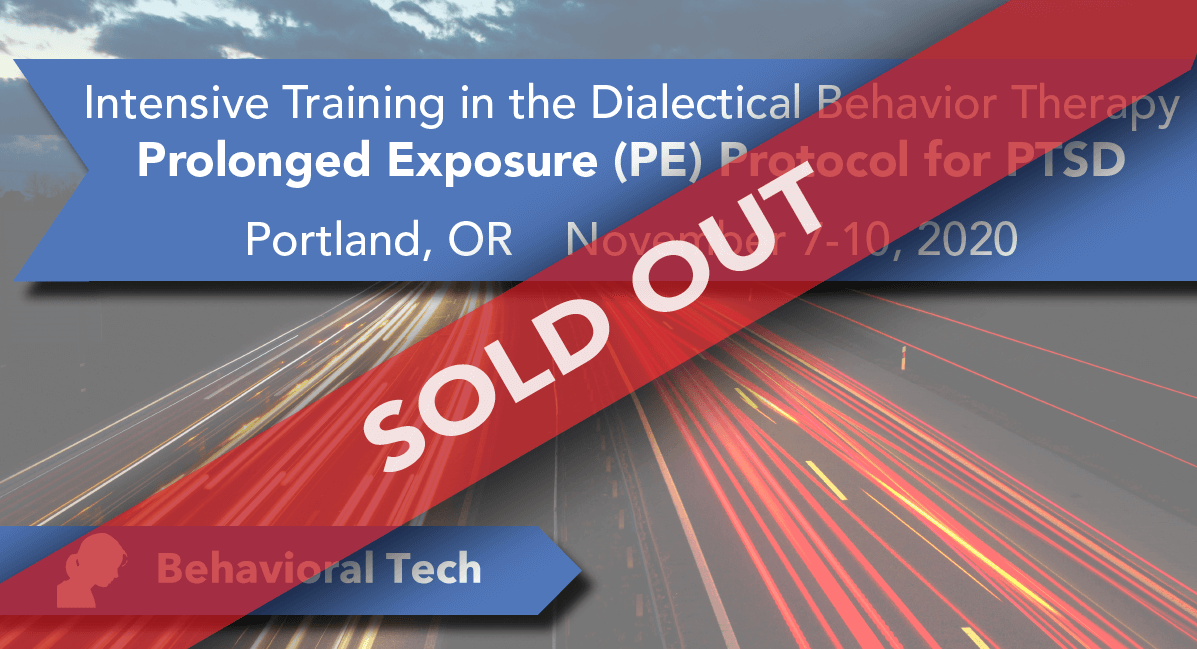
Intensive Training in the Dialectical Behavior Therapy Prolonged Exposure Protocol for PTSD (SOLD OUT)
Level 4
Live, Remote, Instructor-led
Portland, OR — co-hosted by Portland DBT Institute
November 7-10, 2020

Training Description
This 4-day workshop is designed to provide intensive training in how to integrate PTSD treatment into standard DBT. Participants will learn the DBT Prolonged Exposure (DBT PE) protocol for treating PTSD, one of the newest developments in DBT research and practice. This protocol can be added to standard DBT to allow for integrated treatment of PTSD, suicidal and self-injurious behavior, and other co-occurring problems. Participants will learn how to use DBT strategies to prepare high-risk and multi-problem clients for the DBT PE protocol as well as how to determine when clients are ready to begin formal PTSD treatment.
The structure and procedures of the DBT PE protocol will be taught in a session-by-session format with extensive opportunities to watch video examples and practice delivering each of the primary treatment components. Particular attention will be paid to discussing strategies for overcoming common problems that arise during PTSD treatment with high-risk and multi-problem clients as well as how to tailor the treatment to address the complex characteristics of this client population.
This advanced workshop is intended for mental health professionals who have attended a DBT Intensive or Foundational training (or equivalent), are active members of DBT consultation teams, or currently provide DBT individual therapy.
Primary Objective: Implement the DBT PE protocol with clients.
Learning Objectives:
1. Identify DBT strategies to use to prepare high-risk and multi-problem clients for the DBT PE protocol.
2. Determine if clients are ready for formal PTSD treatment.
3. Describe the rationale for using in vivo and imaginal exposure to treat PTSD.
4. Implement the core procedures of the DBT PE protocol (i.e., in vivo and imaginal exposure).
5. Identify strategies for addressing common problems that arise during the DBT PE protocol.
Schedule
| General Schedule | |||
|---|---|---|---|
| 8:00 | – | 8:30 | Registration, Sign-In |
| 8:30 | – | 10:00 | Morning Session 1 |
| 10:00 | – | 10:15 | Break |
| 10:15 | – | 12:00 | Morning Session 2 |
| 12:00 | – | 1:00 | Lunch |
| 1:00 | – | 2:30 | Afternoon Session 1 |
| 2:30 | – | 2:45 | Break |
| 2:45 | – | 4:15 | Afternoon Session 2 |
| 4:15 | – | 4:30 | Q&A, Completion of Evaluation, Sign-Out |
CE NOTE: Behavioral Tech calculates the continuing education credits for this training by the start time and end time. 100 percent attendance is required, as is signing IN and OUT each morning and afternoon, to receive CE credits. Partial credits cannot be issued.
Trainers
Melanie Harned, PhD, ABPP
 Seattle, WA (United States)
Melanie S. Harned, Ph.D., ABPP, is a Psychologist and Coordinator of the DBT Program at the VA Puget Sound Health Care System and an Associate Professor in the Department of Psychiatry and Behavioral Science and Adjunct Associate Professor in the Department of Psychology at the University of Washington. Dr. Harned has previously worked as the Research Director of Dr. Marsha Linehan’s Behavioral Research and Therapy Clinics at the University of Washington (2006-2018), Director of Research and Development for Behavioral Tech, LLC (2014-2017), and Director of Behavioral Tech Research, Inc. (2013-2016). Dr. Harned’s research focuses on the development and evaluation of a protocol to treat PTSD during DBT as well as methods of disseminating and implementing this and other evidence-based treatments into clinical practice. She regularly provides training and consultation nationally and internationally in DBT and DBT PE. She has published numerous articles and book chapters and is licensed as a psychologist in the state of Washington.
Seattle, WA (United States)
Melanie S. Harned, Ph.D., ABPP, is a Psychologist and Coordinator of the DBT Program at the VA Puget Sound Health Care System and an Associate Professor in the Department of Psychiatry and Behavioral Science and Adjunct Associate Professor in the Department of Psychology at the University of Washington. Dr. Harned has previously worked as the Research Director of Dr. Marsha Linehan’s Behavioral Research and Therapy Clinics at the University of Washington (2006-2018), Director of Research and Development for Behavioral Tech, LLC (2014-2017), and Director of Behavioral Tech Research, Inc. (2013-2016). Dr. Harned’s research focuses on the development and evaluation of a protocol to treat PTSD during DBT as well as methods of disseminating and implementing this and other evidence-based treatments into clinical practice. She regularly provides training and consultation nationally and internationally in DBT and DBT PE. She has published numerous articles and book chapters and is licensed as a psychologist in the state of Washington.
Sara Schmidt, PhD
 Seattle, WA (United States)
 Sara Schmidt, PhD, is a licensed clinical psychologist in the state of Washington, where she is in private practice, and a DBT-Linehan of Certification, Certified Clinician™. Until 2021, she served as the Associate Director of the Trauma and Suicide Treatment Research Lab at the Seattle Institute for Biomedical and Clinical Research, part of the VA Puget Sound Health Care System, where she was a Co-Investigator on NIMH-funded research focused on the evaluation and implementation of DBT and the DBT Prolonged Exposure (DBT PE) protocol for PTSD. As part of this work, she co-developed the DBT Adherence Checklist for Individual Therapy (DBT AC-I), a tool that can be used by DBT therapists to evaluate the degree to which they are delivering DBT in a way that is consistent with the treatment manual, as well as the DBT Program Fidelity Checklist (DBT PFC), which enables programs to evaluate their fidelity to DBT and identify potential areas for improvement.
Dr. Schmidt received her BA in Psychology from Wesleyan University, and my MA and PhD in Clinical-Community Psychology from the University of South Carolina. She completed her pre-doctoral internship at Westchester Jewish Community Services in Hartsdale, NY., and her postdoctoral training with Dr. Melanie Harned at the University of Washington’s Behavioral Research and Therapy Clinics (BRTC). Following her postdoctoral fellowship, she remained at the BRTC as a Research Scientist, where she directed the graduate training program in DBT. She currently maintains a Clinical Instructor position through the Department of Psychology supervising advanced doctoral students. She also previously worked as a Research Scientist at Behavioral Tech, LLC, where she assisted in developing training content, methods, and customized implementation plans.
Dr. Schmidt has experience providing DBT in a variety of settings, including community mental health, private practice, and residential facilities, and works with both adults and adolescents. She regularly provides professional trainings and consultation in DBT and DBT PE nationally and internationally and has published several peer reviewed articles and book chapters on these topics.
Sara Schmidt, PhD, is a licensed clinical psychologist in the state of Washington, where she is in private practice, and a DBT-Linehan of Certification, Certified Clinician™. Until 2021, she served as the Associate Director of the Trauma and Suicide Treatment Research Lab at the Seattle Institute for Biomedical and Clinical Research, part of the VA Puget Sound Health Care System, where she was a Co-Investigator on NIMH-funded research focused on the evaluation and implementation of DBT and the DBT Prolonged Exposure (DBT PE) protocol for PTSD. As part of this work, she co-developed the DBT Adherence Checklist for Individual Therapy (DBT AC-I), a tool that can be used by DBT therapists to evaluate the degree to which they are delivering DBT in a way that is consistent with the treatment manual, as well as the DBT Program Fidelity Checklist (DBT PFC), which enables programs to evaluate their fidelity to DBT and identify potential areas for improvement.
Dr. Schmidt received her BA in Psychology from Wesleyan University, and my MA and PhD in Clinical-Community Psychology from the University of South Carolina. She completed her pre-doctoral internship at Westchester Jewish Community Services in Hartsdale, NY., and her postdoctoral training with Dr. Melanie Harned at the University of Washington’s Behavioral Research and Therapy Clinics (BRTC). Following her postdoctoral fellowship, she remained at the BRTC as a Research Scientist, where she directed the graduate training program in DBT. She currently maintains a Clinical Instructor position through the Department of Psychology supervising advanced doctoral students. She also previously worked as a Research Scientist at Behavioral Tech, LLC, where she assisted in developing training content, methods, and customized implementation plans.
Dr. Schmidt has experience providing DBT in a variety of settings, including community mental health, private practice, and residential facilities, and works with both adults and adolescents. She regularly provides professional trainings and consultation in DBT and DBT PE nationally and internationally and has published several peer reviewed articles and book chapters on these topics.
Prerequisites
This 4-day workshop is designed to provide intensive training in how to integrate PTSD treatment into standard DBT. Participants will learn the DBT Prolonged Exposure (DBT PE) protocol for treating PTSD, one of the newest developments in DBT research and practice. This protocol can be added to standard DBT to allow for integrated treatment of PTSD, suicidal and self-injurious behavior, and other co-occurring problems. Participants will learn how to use DBT strategies to prepare high-risk and multi-problem clients for the DBT PE protocol as well as how to determine when clients are ready to begin formal PTSD treatment.
The structure and procedures of the DBT PE protocol will be taught in a session-by-session format with extensive opportunities to watch video examples and practice delivering each of the primary treatment components. Particular attention will be paid to discussing strategies for overcoming common problems that arise during PTSD treatment with high-risk and multi-problem clients as well as how to tailor the treatment to address the complex characteristics of this client population.
This advanced workshop is intended for mental health professionals who have attended a DBT Intensive or Foundational training (or equivalent), are active members of DBT consultation teams, or currently provide DBT individual therapy.
Primary Objective: Implement the DBT PE protocol with clients.
Learning Objectives:
1. Identify DBT strategies to use to prepare high-risk and multi-problem clients for the DBT PE protocol.
2. Determine if clients are ready for formal PTSD treatment.
3. Describe the rationale for using in vivo and imaginal exposure to treat PTSD.
4. Implement the core procedures of the DBT PE protocol (i.e., in vivo and imaginal exposure).
5. Identify strategies for addressing common problems that arise during the DBT PE protocol.
Technical Requirements
Training Location
Kennedy School
5736 NE 33rd Ave.
Portland, OR 97211
Continuing Education
This offering meets the requirements for the following hours by discipline. Licensing and continuing education requirements vary by state. Please contact your state’s regulatory authority to verify if this course meets your licensing or continuing education requirements. Inquiries regarding CE for other disciplines not listed may be directed to Behavioral Tech at 206.675.8588 or via email to support@behavioraltech.org. For general CE questions, you can also view our continuing education FAQs.
CE NOTE: Behavioral Tech calculates the continuing education credits for this training by the start time and end time. 100 percent attendance is required, as is signing IN and OUT each morning and afternoon, to receive CE credits. Partial credits cannot be issued.
Alcohol and Drug Abuse Counselors
Behavioral Tech is approved the NAADAC – the Association for Addiction Professionals, Provider #77431. You will receive a letter via email documenting your attendance upon successful completion of the activity. The allotted contact hours for this activity = 25.
Mental Health Counselors
Behavioral Tech is approved a NBCC-Approved Continuing Education Provider (ACEP™), ACEP No. 5885. Programs that do not qualify for NBCC credit are clearly identified. Behavioral Tech, LLC, is solely responsible for all aspects of the program. Behavioral Tech will email you a letter documenting your attendance upon successful completion of the activity. The allocated clock hours for this activity = 25.
Nurses
Behavioral Tech is accredited the Accreditation Council for Continuing Medical Education to provide continuing medical education for physicians. Nurses should only claim credit commensurate with the extent of their participation in the activity. Continuing Medical Education is accepted by the ANCC for nursing certification renewal. The maximum AMA PRA Category 1 Credits™ designated by Behavioral Tech for this activity = 25.
At the end of the training, each Nurse must complete and sign the provided form to record the number of credits claimed. Keep one copy & return the other copy to Behavioral Tech.
Psychiatrists
Behavioral Tech is accredited the Accreditation Council for Continuing Medical Education to provide continuing medical education for physicians. Physicians should only claim credit commensurate with the extent of their participation in the activity. The maximum AMA PRA Category 1 Credits™ designated by Behavioral Tech for this activity = 25.
At the end of the training, each Physician must complete and sign the provided form to record the number of credits claimed. Keep one copy & return the other copy to Behavioral Tech.
Psychologists
Behavioral Tech is approved the American Psychological Association to offer continuing education for psychologists. Behavioral Tech maintains responsibility for the program and its content. Behavioral Tech will email you a letter documenting your attendance after successful completion of the program and homework. The number of hours Behavioral Tech has allocated within APA guidelines = 25.
Social Workers- WA
Behavioral Tech will apply the NASW, Washington State Chapter, Provider Number 1975-166, to offer continuing education for Certified Social Workers. Behavioral Tech will email a certificate of attendance upon 100% completion of this activity. The hours of CE allocated for this activity = 25.
Information about the Instructor(s)
Melanie S. Harned, Ph.D., ABPP, is a Psychologist and Coordinator of the DBT Program at the VA Puget Sound Health Care System and an Associate Professor in the Department of Psychiatry and Behavioral Science and Adjunct Associate Professor in the Department of Psychology at the University of Washington. Dr. Harned has previously worked as the Research Director of Dr. Marsha Linehan’s Behavioral Research and Therapy Clinics at the University of Washington (2006-2018), Director of Research and Development for Behavioral Tech, LLC (2014-2017), and Director of Behavioral Tech Research, Inc. (2013-2016). Dr. Harned’s research focuses on the development and evaluation of a protocol to treat PTSD during DBT as well as methods of disseminating and implementing this and other evidence-based treatments into clinical practice. She regularly provides training and consultation nationally and internationally in DBT and DBT PE. She has published numerous articles and book chapters and is licensed as a psychologist in the state of Washington.
Faculty Disclosure Statement:
Melanie Harned, PhD, ABPP, is paid to provide training and consultation with Behavioral Tech, LLC. Her research on DBT and DBT PE is funded by US Federal Government.
Behavioral Tech Policies Regarding Faculty Disclosure and Disclaimers
Conflict of interest definition: A conflict of interest may be considered to exist if a continuing education course faculty is affiliated with, or has any significant financial interest, in any organization(s) that may have a direct interest in the subject matter of the presentation or may be co-sponsoring or offering financial support to the course. Situations involving a potential conflict of interest are not inherently bad or wrong, but in accordance with standards for continuing medical education
we would like you to be aware of the affiliation/financial interest of your instructors.
Faculty Disclaimer: When an unlabelled use of a commercial product, or an investigative use not yet approved for any purpose is discussed during an educational activity, we shall require the speaker to disclose that the product is not labeled for the use under discussion or that the product is still investigative.
Notice of requirements for successful completion: Participants must attend 100% of the training to receive a certificate of successful completion. This includes signing in and out each day of the event.
Commercial support or sponsorship: There is no commercial company support for this CME/CE event.
Noncommercial Sponsor Support: There is no noncommercial sponsor support for this CME/CE activity.
Non-Endorsement of Products: The Behavioral Tech approval status refers only to continuing education activities and does not imply that there is real or implied endorsement of any product, service, or company referred to in this activity nor of any company subsidizing costs related to the activity.
Off-Label Product Use: This CME/CE activity does not include any unannounced information about off-label use of a product for a purpose other than that for which it was approved by the Food and Drug Administration (FDA).
Not finding the training you’re looking for? Check out our services for agencies and systems to learn if we can bring a training to you!